

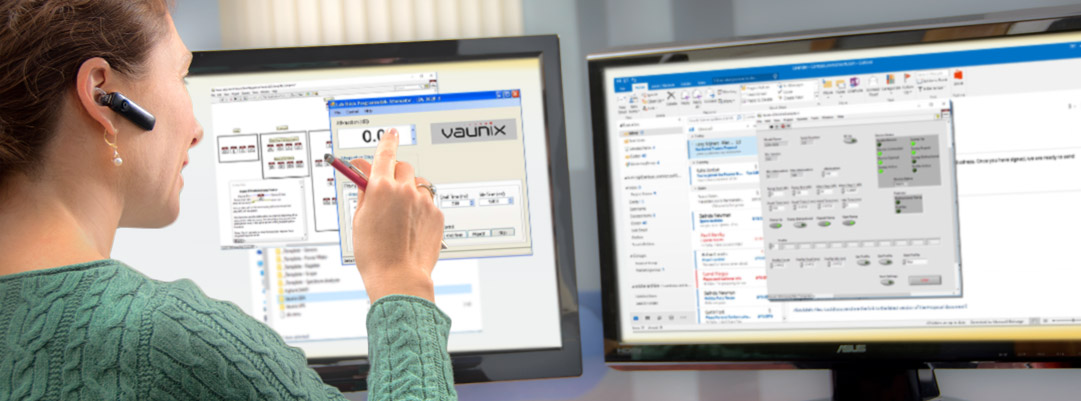
We're your wireless ATE support team
Looking to say "hello" to someone who can help you with saying "good-bye" to wireless signal path problems, test equipment failures, and configuration challenges? Can't find a Lab Brick software set up guide, or need a specific Lab Brick application question answered? You're in the right place. Vaunix provides technical support to our customers and future customer contacts worldwide. We're here to answer the who, what, where, when, why, and how of cellular infrastructure, RF communications, and wireless ATE problems of all kinds, including 5G. We're especially experienced in finding unique ways to employ our portable, programmable devices to create efficient and nimble RF and microwave ATE set ups. Our staff of experienced radio technicians and test engineers is here to help 24/7. Start by reviewing our FAQs, our informative blogs, and our technical resources for immediate insights, and submit your questions directly to our technical team by using the simple form on this page. And if your needs are especially urgent, just call us at 978-662-7839. We look forward to helping you.
Hardware FAQs
Each Lab Brick ships with the instrument, a USB cable, and access to the Vaunix software download page. Refer to the individual product datasheet for full packaging details by model.
Yes. Lab Brick signal generators support external reference input and can be daisy-chained to share a single reference, enabling phase-coherent multi-channel setups for MIMO and beamforming test configurations.
Vaunix specifies phase shift accuracy at ±2.5° for the LPS series. Each unit applies a phase shift within this tolerance, allowing predictable error budgeting across multi-unit phased array and beamforming test setups.
The 10-pin expansion bus header allows multiple compatible Lab Brick devices to be daisy-chained and controlled through a single USB or Ethernet connection. All interconnected units are accessible via the Windows GUI, Web UI, or SDK — no additional connections required. This configuration is commonly used in rack-mount solutions where multiple units are integrated into a 1U or 2U chassis.
Select LMS models support pulse modulation, sweep triggering, and external reference input. Advanced models also include optional RF output configurations. Check individual model datasheets for feature availability.
Software FAQs
Yes. All Lab Brick instruments are supported by the Vaunix API, which is compatible with Python, C, LabVIEW, and other common programming environments. API documentation and SDK downloads are available on the software page.
Multiple Lab Brick units can be connected to a single computer via USB and addressed independently. Each unit is assigned a unique identifier, allowing simultaneous or sequenced control in automated test setups.
Yes. When multiple LDA attenuators are connected via USB, the API assigns each a unique handle. Attenuation values can be set independently or simultaneously across all connected units within the same control session.
LDA digital attenuators can be programmed to step through attenuation profiles that replicate fading and dropout conditions. The Vaunix API supports timed sequences, and the Web UI allows manual profile configuration for simpler setups.
Recommended dwell time depends on the specific model and application. Switching speeds range from 15 µs to 350 ms across the LDA series — refer to the datasheet for your model and contact support if you need guidance for a specific test scenario.
Yes. Lab Brick instruments support autonomous operation, allowing them to run pre-loaded profiles without a continuous host computer connection. Settings are stored in internal memory and executed on power-up.
Software Downloads
- Digital Attenuators
- Signal Generators
- RF Switches
- Phase Shifters
Resources
- Datasheets
- Tech Briefs
Contact Our Support Team
Vaunix | 978-662-7839 | 7 New Pasture Road | Newburyport, MA 01950


Vaunix | 978-662-7839 | 7 New Pasture Road | Newburyport, MA 01950