

How a 40 GHz Signal Generator Streamlines Millimeter-Wave Testing
By Scott Blanchard, Co-Founder & President, Vaunix Technology Corporation
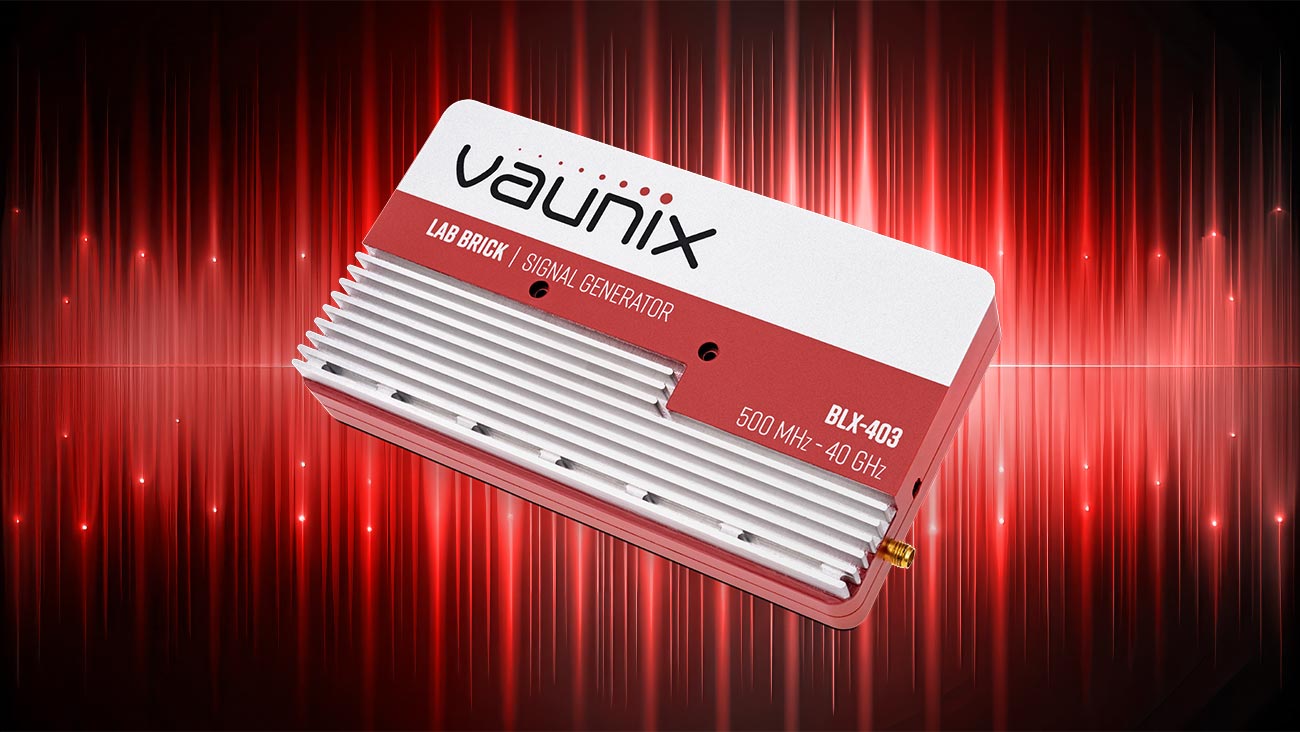
Millimeter-wave testing places unique demands on signal sources, particularly as operating frequencies extend beyond traditional microwave bands. At higher frequencies, signal stability, repeatability, and test setup complexity have a direct impact on measurement quality and workflow efficiency.
A 40 GHz signal generator provides the frequency coverage and control required to support a wide range of millimeter-wave applications in a single, compact instrument. In practical terms, access to calibrated output power, fine frequency resolution, and programmable control helps engineers simplify high-frequency testing without expanding bench space or system complexity.
This post explains:
- Why millimeter-wave testing places stricter requirements on signal sources
- How a 40 GHz signal generator supports both lab and automated test environments
- Where compact, programmable generators fit into modern millimeter-wave workflows
The discussion includes a closer look at the BLX-403 from Vaunix as an example of how these capabilities are implemented in practice.
Key Takeaways
- Millimeter-wave testing places tighter requirements on signal sources, where stability, repeatability, and frequency coverage directly affect measurement accuracy and workflow efficiency.
- A 40 GHz signal generator provides practical coverage for lower millimeter-wave applications, supporting both lab and automated test environments without adding unnecessary system complexity.
- Compact, programmable signal generators simplify high-frequency test setups, particularly in automated and space-constrained environments where integration and repeatability matter more than manual control.
Why Millimeter-Wave Testing Demands Specialized Signal Sources
Millimeter-wave frequencies - typically defined as signals above 30 GHz - introduce challenges that do not appear at lower RF and microwave bands. As frequencies increase, small variations in signal quality have a greater impact on measurement accuracy.
Key Challenges at Millimeter-Wave Frequencies
- Increased sensitivity to cable losses and connector performance
- Greater impact of source stability on repeatability
- Tighter tolerances for output power and frequency accuracy
- Higher risk of measurement error when validating components near operating limits
Traditional benchtop instruments, including large microwave signal generators, can address these frequencies, but they often introduce trade-offs in size, cost, and integration effort. In many test environments, engineers need a source that can be deployed closer to the device under test, controlled programmatically, and integrated into automated workflows without extensive setup.
A 40 GHz signal generator provides sufficient headroom to support a wide range of millimeter-wave test scenarios while remaining practical for day-to-day lab and production use.
What a 40 GHz Signal Generator Enables in Practice
From a testing perspective, access to the required frequency range allows engineers to operate in the lower millimeter-wave spectrum with consistent control and repeatability. This capability is especially useful in environments where multiple test configurations or rapid iteration are required.
Key advantages include:
- Broad frequency coverage that supports both microwave and millimeter-wave testing with a single RF signal generator
- Fine frequency resolution, allowing precise stimulus control during characterization and validation
- Calibrated output power across the operating range, reducing the need for external correction
- Low non-harmonic spurious content, helping ensure cleaner stimulus signals at higher frequencies
For engineers working across different projects or product generations, these characteristics help reduce the number of instruments required on the bench or in the rack.
Streamlining Automated and Programmatic Test Setups
Millimeter-wave testing is increasingly automated. Whether in production test, ATE environments, or research labs running long measurement sequences, the ability to control a programmable RF source programmatically is critical.
Automation Requirements in High-Frequency Testing
Modern USB RF signal generators and other programmable signal sources simplify this process by offering software interfaces designed for automation rather than manual front-panel control. Test scripts can manage frequency changes, power levels, sweeps, and modulation directly within the test application.
Interface Options for System Integration
The BLX-403 supports both USB and Ethernet interfaces, giving engineers flexibility in how the RF signal generator is deployed. USB HID control eliminates the need for custom drivers, while Ethernet access via HTTP simplifies integration into networked or embedded test systems, including Linux-based environments.
Compact Form Factors and Portable Testing
Another practical consideration in millimeter-wave testing is physical space. High-frequency setups often involve multiple instruments, fixtures, and accessories, and layout decisions can affect both workflow and signal integrity.
Managing Footprint in High-Frequency Test Setups
Compact USB RF signal generators reduce cable lengths and simplify bench layouts. Shorter signal paths help limit loss and variability, while smaller instruments make it easier to organize crowded benches or racks.
In some cases, these generators can be placed directly within a test fixture or rack-mounted as part of an automated system. This approach is especially useful in production or ATE environments where consistency and repeatability matter more than manual access.
Portability Across Test Environments
Portable microwave signal generators also make it easier to move a calibrated source between lab benches, test stations, or development environments without reconfiguring the setup. For teams supporting multiple projects or test locations, portability reduces setup time while maintaining measurement consistency.
The Role of the BLX-403 in Millimeter-Wave Testing
The BLX-403 is designed to address these practical requirements while covering frequencies from 500 MHz to 40 GHz. Its wide operating range allows a single 40 GHz signal generator to support both traditional RF testing and millimeter-wave applications.
Key Capabilities at Millimeter-Wave Frequencies
- 100 Hz frequency resolution for precise tuning
- Calibrated output power control across the full frequency range
- Low non-harmonic spurious energy, supporting cleaner high-frequency stimulus signals
- Frequency sweeping and pulse modulation, with internal or external references
- USB and Ethernet control, positioning the unit as a flexible programmable RF source for automated test systems
These features make the BLX-403 suitable for engineering labs, production test systems, and automated environments where a compact RF signal generator is required at millimeter-wave frequencies.
Reducing Complexity Without Sacrificing Control
One of the ongoing challenges in high-frequency testing is balancing capability with usability. Instruments that offer broad frequency coverage and advanced features can also introduce complexity, particularly when they are designed primarily for manual operation.
By focusing on software-driven control and a compact form factor, a USB RF signal generator like the BLX-403 helps reduce setup time and simplify integration. Engineers can focus on test logic and measurement accuracy rather than instrument management, which becomes increasingly important as test environments scale.
When a 40 GHz Signal Generator Makes Sense
A 40 GHz signal generator is a practical choice when testing needs extend beyond conventional microwave bands but do not require higher-frequency millimeter-wave sources. Common scenarios include:
- Component and subsystem characterization approaching mmWave frequencies
- Automated test systems that benefit from a compact programmable RF source
- Engineering labs supporting multiple RF and microwave projects
- Production environments requiring consistent, repeatable stimulus signals from a microwave signal generator
In these cases, a single 40 GHz signal generator can simplify both hardware and software architectures.
Frequently Asked Questions About 40 GHz Signal Generators and Millimeter-Wave Testing
What is a 40 GHz signal generator used for?
A 40 GHz signal generator is used to produce controlled RF and microwave signals for testing components, subsystems, and systems operating at high frequencies, including millimeter-wave applications.
Is 40 GHz considered millimeter-wave?
Yes. Frequencies above approximately 30 GHz fall into the millimeter-wave range, making a 40 GHz signal generator suitable for lower millimeter-wave testing.
Why use a USB RF signal generator instead of a benchtop instrument?
A USB RF signal generator is typically more compact and easier to integrate into automated or portable test setups. It is well suited for programmatic control and reduces bench space compared to traditional benchtop microwave signal generators.
What features matter most for millimeter-wave signal generation?
Important features include frequency range, frequency resolution, calibrated output power, spurious performance, and reliable software control - core requirements for any programmable RF source operating at millimeter-wave frequencies.
Can a programmable RF source be used in automated test equipment?
Yes. A programmable RF source with USB or Ethernet control is commonly used in ATE environments, where it can be controlled through APIs or test scripts to support repeatable, high-throughput testing.
Learn More About Vaunix Signal Generators
Vaunix offers a range of digital RF signal generators designed for programmable control, compact integration, and high-frequency testing. Contact us to discuss your millimeter-wave testing requirements and signal generation needs.
Read More
Modern RF Test Solutions: Four Featured Vaunix Lab Brick Products for Multi-Channel Workflows
EverythingRF Interviews Scott Blanchard
Butler Matrix: Applications, Design Tradeoffs, and Modern Lab Implementations
Scott Blanchard is an RF/microwave engineer with more than 30 years of experience designing radio systems, RF components, and wireless infrastructure. Before founding Vaunix, he held key engineering and leadership roles at Motorola, Advanced Techcom, and Nera Networks. Scott's vision for compact, programmable Lab Brick® test products and flexible rackmount solutions has helped transform how R&D labs and production facilities approach automated RF testing. He holds a BSEE from the University of Colorado and continues to lead Vaunix's product development and technology strategy.
Vaunix | 978-662-7839 | 7 New Pasture Road | Newburyport, MA 01950


Vaunix | 978-662-7839 | 7 New Pasture Road | Newburyport, MA 01950